Keep Fighting: Fetal Care Center Helps Family Through a Rare Prenatal Diagnosis
When Jill learned her baby had a rare, potentially fatal condition, a team of highly skilled physicians brought advanced care and similar determination to beat the odds.
7 minutes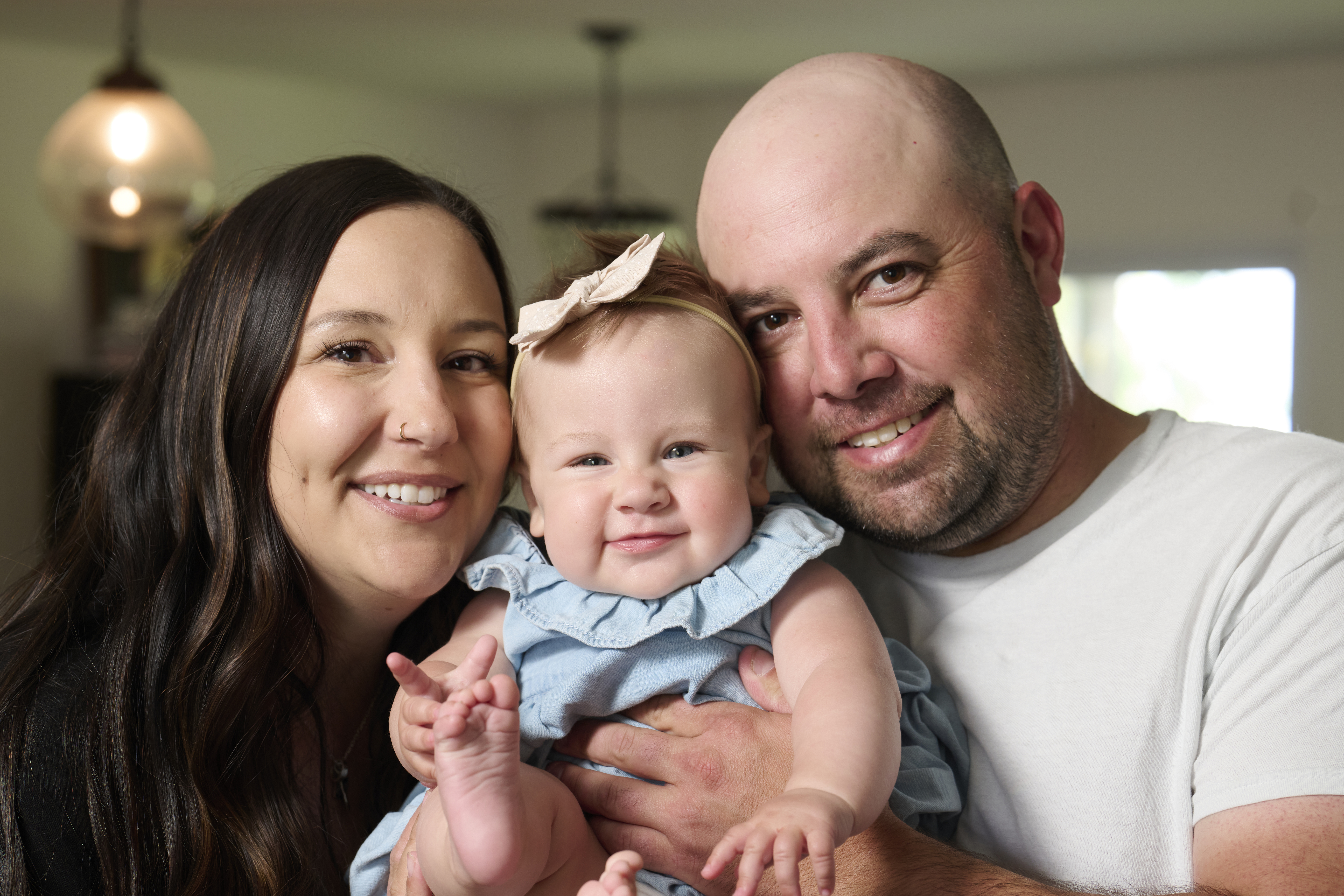
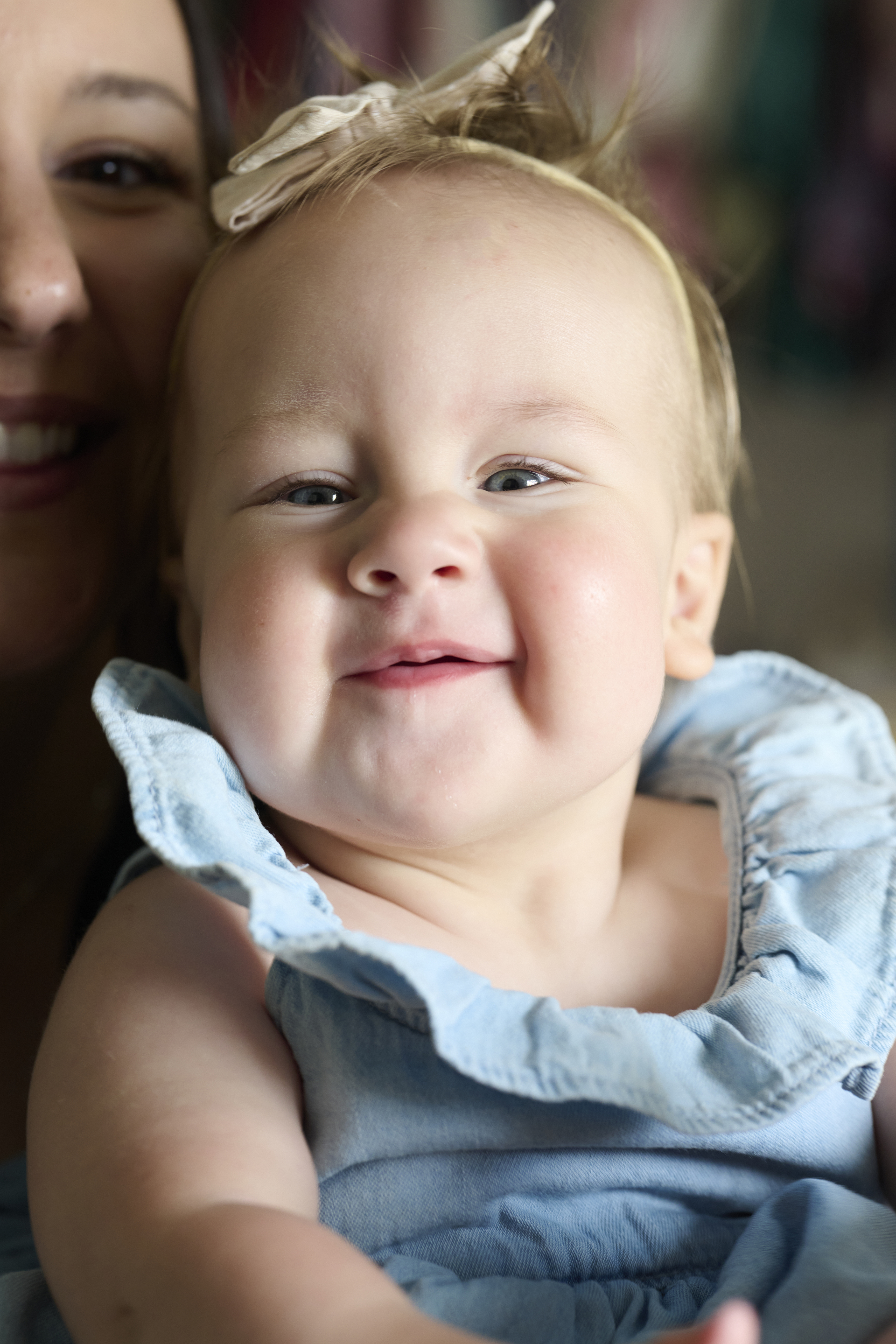
While Jill is telling the story of her daughter’s birth, she pauses to bring Olive—the main character—into the conversation. Now five months old, Olive is wriggling with excitement, hair still matted from her nap, blue eyes lighting up at the sound of her mother’s voice.
Hoping for these small moments with Olive is what pushed Jill through an emotionally trying pregnancy. When Olive was diagnosed with a rare, potentially fatal condition while in the womb, Jill went looking for answers. When previous losses allowed doubt to creep into her mind, it didn’t stay there for long.
Because in Jill’s mind, her and Olive’s journey only had one conclusion. And thanks to that bottomless supply of belief and the advanced expertise of her team at the Fetal Care Center, a collaboration among Barnes-Jewish Hospital, WashU Medicine, and St. Louis Children’s Hospital, Jill reached it.
An olive branch
Jill, 34, suffered one miscarriage before giving birth to her daughter, Zoey. Less than two years later, Zoey passed away unexpectedly, an unimaginable loss that left Jill and her husband, Alex, changed forever.
“Finding words to describe this type of grief is hard, and our hearts will always have a hole where she belongs,” Jill says.
Jill and Alex experienced two more miscarriages, but they never stopped believing their time would come. While reading the story of Noah’s Ark to her nephew one night, Jill got to the part of the story about olive branches and their meaning. Though she wasn’t pregnant at the time, she knew she would be—and she had the perfect name for her daughter.
“She will be our olive branch after all the loss we endured,” Jill says. “A symbol of peace, hope, and promise of life.”
Eventually, after two more miscarriages, Jill and Alex learned they were expecting again. As excited as they were, their past experiences had the couple “waiting for the other shoe to drop.” But as Jill got further into this pregnancy, their optimism grew.
"We started planning things and making purchases, and our mindset had shifted because we thought we were at this safety point,” Jill says. “We were excited. Then, we had our 22-week anatomy scan, and life changed completely."
“Not again”
At that anatomy scan, a detailed ultrasound that occurs during a pregnancy’s second trimester, Jill and Alex’s baby was diagnosed with hydrops, a rare condition that occurs in 1 in 2,000 pregnancies. When present, hydrops causes fluid to accumulate around a fetus’ vital organs, which can slow down development and lead to pregnancy complications or stillbirths.
When Cherese Y. Collins, MD, Jill’s BJC Medical Group OB-GYN, told the couple about the diagnosis, Jill remembers feeling sick, numb, and angry when hearing the news. They’d fought to get to this point, and they didn’t intend to stop here.
“I told Dr. Collins, ‘I’m not going home,’” Jill says. “I asked her which specialist we needed to see to discuss what our options were.”
Dr. Collins referred Jill to a team of WashU Medicine maternal-fetal medicine physicians, specialists who provide advanced expertise in diagnosing, managing, and supporting high-risk pregnancies like Jill’s, at the Fetal Care Center.
The Fetal Care Center at Barnes-Jewish Hospital, WashU Medicine, and St. Louis Children’s Hospital provides advanced, region-leading care for mothers and babies, taking a multidisciplinary approach that connects families with cutting-edge treatments from maternal-fetal medicine specialists, neonatologists, pediatric cardiologists, and other experts to ensure every area of high-risk pregnancy is covered. The Fetal Care Center’s team also works closely with St. Louis Children’s Level IV newborn intensive care unit (NICU), the highest level of care available for newborns, to ensure a smooth transition for babies who need specialized care after birth.
“I knew Jill wasn’t going to do anything other than fight, even with the chances not in our favor,” Alex says. “I just told her that if she wants to keep going, I support her.”
A few days later, the couple met Katherine H. Bligard, MD, MA, a WashU Medicine maternal-fetal medicine specialist and associate director of the Fetal Care Center. Jill told Dr. Bligard about every pregnancy complication she and Alex had. After everything they’d been through, Dr. Bligard made them feel heard and understood as they faced this new diagnosis.
Never a doubt
Dr. Bligard recommended a minimally invasive procedure to drain the excess fluid from around the baby’s lungs to identify what was causing the hydrops. The procedure required as much precision as it did expertise, as Dr. Bligard accessed the fluid by inserting a needle into Jill’s abdomen to remove the fluid from around the baby’s organs. Aided by a sonographer, Dr. Bligard performed the drainage safely within 10 minutes.
When the fluid began to reaccumulate and the tests came back inconclusive, Dr. Bligard was honest with Jill—a hydrops diagnosis with no clear cause is usually fatal. Understanding that, Jill still put faith in her care team’s skill, and her own instincts, that everything would work out.
“I don't know if it was delusion or just trusting my gut, but I just knew the baby was going to be OK,” Jill says.
Despite performing a range of tests, the cause for the hydrops remained unclear. When Jill was 24 weeks pregnant, Dr. Bligard and a sonographer performed a small operation on Jill, again going through her abdomen to place two shunts in the fetus’ chest to divert the excess fluid away from the lungs.
The Fetal Care Center performs this procedure more than any other center in the Midwest, and it takes a total team effort to make it happen.
"I think our expertise for this type of procedure is because we have two maternal-fetal medicine specialists who can do it, sonographers who have experience with draining effusions and placing shunts, and a surgical resource team at Barnes-Jewish that knows exactly how to make these happen easily,” Dr. Bligard said. “And our sonographers are so great with our patients in not only knowing what they need to see, but also being able to document those findings so we know how to interpret the findings on an image."
A few weeks after performing another procedure to replace one of the shunts, the baby’s condition improved. Dr. Bligard’s team saw Jill twice a week for the remainder of her pregnancy.
“During her pregnancy, Jill met with WashU Medicine maternal-fetal medicine physicians, neonatologists, and geneticists to understand what the Fetal Care Center can offer, what the risks were, and what the plan is after delivery,” Dr. Bligard says. “The cross-specialty connections at the Fetal Care Center are so critical to helping us consider the whole picture of a pregnancy and not just the current issue.”
Finally real
Jill’s water broke at 35 weeks, and she delivered Olive at Barnes-Jewish Hospital. Olive was moved to the NICU at St. Louis Children’s Hospital so her lungs could get a little stronger and she could be tested to see what caused the hydrops.
St. Louis Children’s NICU uses state-of-the-art treatments and therapies to care for more than 1,700 babies annually. Plus, the walkway between it and Barnes-Jewish provides parents easy access to bond with their newborns during the first hours and days post-delivery.
Jill remembers slowly walking across to visit Olive in the NICU not long after delivering her. When Jill arrived, she and Olive were alone. It had been a long journey to get here for Jill, one where it was difficult to relax or reflect. But during that quiet moment with her daughter, so many of the emotions Jill had pushed away finally arrived.
“It was the first time I was alone with her, and I just lost it and started crying,” Jill says. “Up until that that point, I felt very much in fight mode, like we were fighting the odds; that was the first moment where it all felt real to me.”
Olive spent 29 days in the NICU, and the team marveled at her quick improvement. Today, Olive is healthy and happy. She doesn't yet know the obstacles she overcame, but her mom plans to tell her all about it one day as a reminder to never give up.
“I trusted my gut, and I’m glad I did because Olive is here,” Jill says. “I can’t thank Dr. Bligard for hearing us, knowing our values, and helping us do what it took to get here—there’s no doubt in my mind that Zoey helped us fall into Dr. Bligard’s hands.”
The Fetal Care Center, a collaboration among Barnes-Jewish Hospital, WashU Medicine, and St. Louis Children’s Hospital, provides leading-edge care from a team of maternal and fetal care specialists to help mothers and babies facing high-risk pregnancies before, during, and after delivery. Learn more about our fetal care services.
Relevant News
Patient Story
Gastric Sleeve Surgery Helped a Mom Say Yes Again
Patient Story
A Trusted Doctor, a Mammogram, and Care That Stayed Connected
Patient Story
Old Friends Lean On One Another Through High-Risk Pregnancies
Patient Story
A Pregnancy Journey Built on Intention
Patient Story
Treating MS is Personal for Dr. Jameson Holloman
Patient Story