From Strangers to ‘Brothers’: Double Lung Transplant Recipients Forge Lasting Friendship
Keith and David received lifesaving care—and a friend for life
6 minutes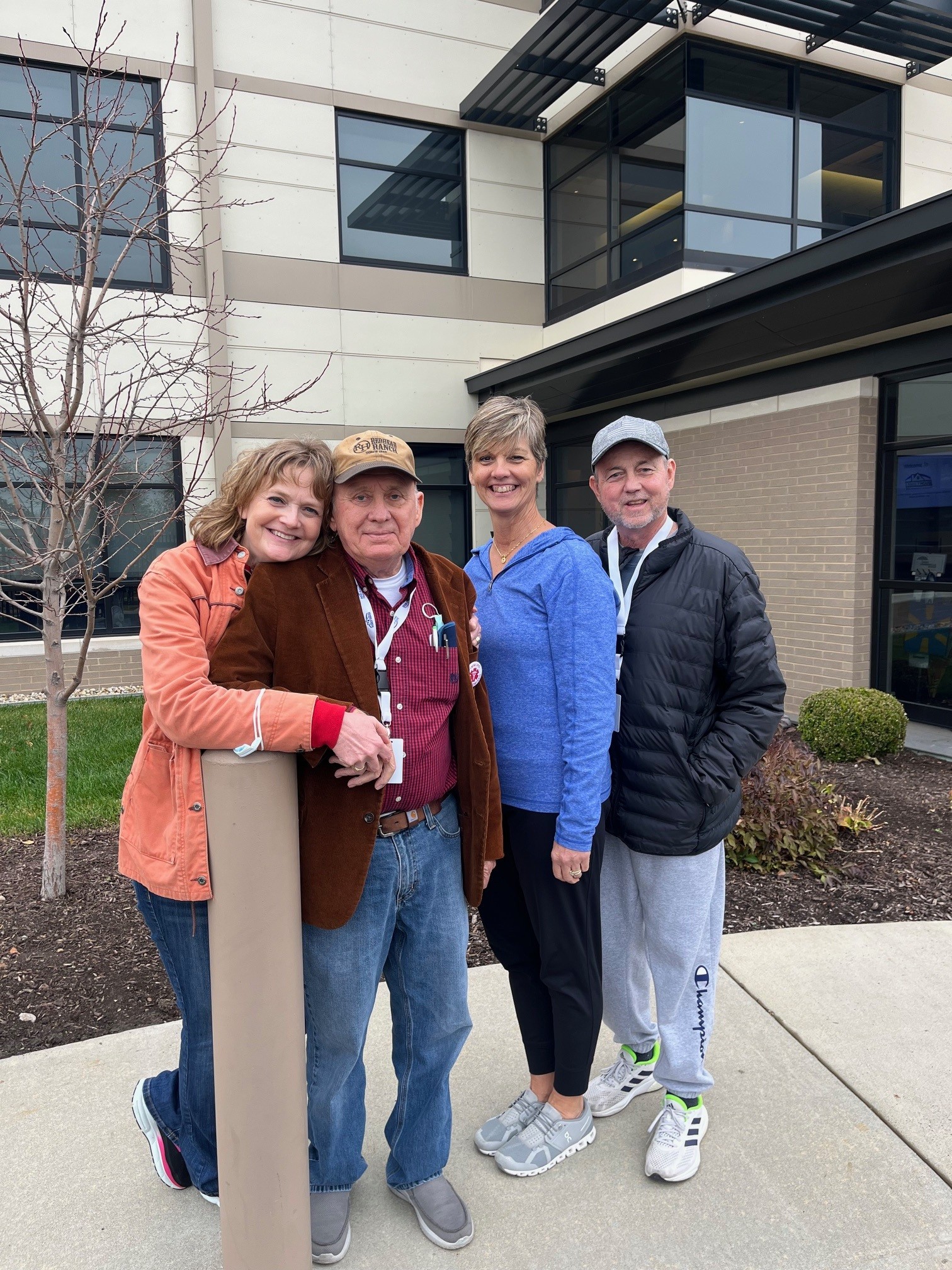 Seeing Keith Waterman, 68, and David Fiedler, 63, interact with one another, it would be easy to assume they’ve been close for decades.
When David has a buzz cut, his wife jokes, the two even look alike.
But Keith and David were strangers with only two obvious things in common when they met in the summer of 2025.
Both men needed double lung transplants, and both turned to the WashU Medicine and Barnes-Jewish Transplant Center, one of the largest organ transplant programs in the nation for their care.
Trusting a national leader in organ transplantation
Keith and his wife, Amy Hagen, started seeing WashU Medicine physicians at Barnes-Jewish Hospital in 2018 for treatment of Keith’s chronic obstructive pulmonary disease (COPD). They made the hour-and-a-half drive from their home in Taylorville, Illinois, returning to the city where they were engaged to be married, this time to seek answers for a condition that was threatening Keith’s life.
As Keith’s lung function declined due to his COPD—it reached 19% at one point—he spent most of his time sitting in a chair or sleeping. With expert care from Rodrigo Vazquez Guillamet, MD, a WashU Medicine pulmonologist at Barnes-Jewish Hospital who specializes in COPD and lung transplantation, Keith was placed on the wait list for a double lung transplant.
“I just couldn’t breathe anymore,” Keith says.
David and his wife, Caren Fiedler, received a referral for David to see Laura Halverson, MD, a WashU Medicine pulmonologist at Barnes-Jewish Hospital who specializes in treating transplant recipients. From their home near Macon, Missouri, they made the nearly three-hour drive in hopes of finding a solution.
David’s persistent cough had grown progressively worse until a choking emergency occurred. At another hospital, he had been diagnosed with idiopathic pulmonary fibrosis, a lung disease in which scarring builds up over time, making it harder to breathe. The exact cause of David’s lung disease was unknown. What he needed—a double lung transplant—was clear. He completed a lung transplant evaluation at Barnes-Jewish and was then placed on the waiting list.
The WashU Medicine and Barnes-Jewish Transplant Center provides advanced care for patients navigating lung failure and other complicated lung diseases. WashU Medicine thoracic surgeons are pioneers in transplantation, performing the first successful adult lung transplant at what was then Barnes Hospital in 1988. Since then, they have performed more than 2,200 lung transplants, including more than 125 lung transplants over the last two years.
At the Center, a multidisciplinary team solely dedicated to transplantation collaborates to manage care before, during, and after surgery. Deep clinical expertise and decades of experience support patients like Keith and David. Their lung transplant teams included pulmonologists, transplant surgeons, anesthesiologists, nurse coordinators, advanced practice providers, pharmacists, dietitians, physical therapists, pulmonary rehabilitation specialists, social workers, and financial coordinators.
“Some people give 100%,” David says. “The team at the Center gives 150%. They are flat-out awesome.”
Two phone calls—and three doors apart
Keith received his transplant call in August 2025. Whitney Brandt, MD, a WashU Medicine cardiothoracic and transplant surgeon on the Center’s lung transplant care team, performed his double lung transplant.
After Keith’s initial recovery, he was discharged from Barnes-Jewish Hospital and checked into Mid-America Transplant’s Family House, where he and Amy had decided to stay during the recovery and rehabilitation process.
Mid-America Transplant created the Family House for patients who temporarily move to St. Louis to be close to lifesaving transplant care. The location offers fully furnished apartment-style accommodations that allow families to stay together just minutes from Barnes-Jewish Hospital. Stays at the Family House can last weeks or months, and the low- or no-cost housing helps families focus on healing instead of logistics and budgets.
“Honestly, the Family House thought of everything,” Amy says. “You don’t have to bring anything other than your personal effects. After Keith got out of the hospital, we changed his shirts multiple times per day. Having laundry in the apartment was so nice. It’s comfortable. It’s safe. We could just concentrate on getting better.”
There’s another Family House benefit. Patients recovering from transplants meet, encourage and inspire one another.
David received his transplant call in September 2025. Varun Puri, MD, a WashU Medicine cardiothoracic and transplant surgeon on the Center’s lung transplant care team, performed the double lung transplant.
David and Caren also had plans to stay at the Family House during his recovery and rehabilitation.
When Caren arrived at the Family House to prepare things for David’s arrival, she encountered Amy, who happened to be staying with Keith just three doors down.
A friendship grows
Wearing masks to minimize the risk of infection, the two couples talked at length soon after David arrived at the Family House. Many long discussions, walks, and adventures followed.
Five times a week, Keith and David reported to Barnes-Jewish Hospital for pulmonary rehabilitation, follow-up appointments, blood tests, X-rays, and other important steps transplant recipients navigate.
A growing bond strengthened during demanding physical rehabilitation sessions, where they were challenged to do a little more every day.
“What I admired about David is that he really worked hard,” Keith says. “He really put the effort into his physical rehab. It was an inspiration to me.”
“Keith was always there for me,” David adds. “He was ahead of me in the process, so I’d ask him how he felt about something. He shared everything.”
As Keith and David built back their strength, they joined their wives and explored all St. Louis has to offer. Their shared adventures included dinners on The Hill and trips to the Missouri Botanical Garden, the Saint Louis Zoo, and Pere Marquette State Park.
One memorable night still gets belly laughs today. The four made a dinner reservation at the restaurant where Keith and Amy got engaged nearly 15 years before—or so they thought. Halfway through the dinner, Keith and Amy realized they had accidentally booked a table at the wrong establishment. The night was saved by Caren’s suggestion to relocate for dessert at the right restaurant, where the owner came out and serenaded the friends.
A lasting bond
Keith and Amy were able to return home to Taylorville after a 12-week stay in St. Louis.
Every Sunday, an alarm goes off at 7:01 a.m.—the time Keith got his transplant phone call—and the couple takes a moment to stop and say thanks for Keith’s organ donor, his care team, and his second chance at life.
“I haven’t felt this good in 20 years,” Keith says. “I’m so much more active now.”
They remain in constant communication with David and Caren, who spent six months at the Family House during David’s recovery before returning home in March.
“I’m breathing without an oxygen tank again,” David says. “That’s 100% in my book.”
Despite no longer being a few doors down from one another, there have been more meetups for dinners between the couples, too many laughs to count, and one gift that captures the power of this friendship.
When Amy gave Keith a new photo album after he returned home, he flipped through it to see David and Caren pictured time and time again.
“We can’t have a lung transplant story without David and Caren in it,” Amy says. “Keith and David refer to one another as brothers, and that’s what they are now.”
Learn more about the WashU Medicine and Barnes-Jewish Transplant Center.
Relevant News
Patient Story
Gastric Sleeve Surgery Helped a Mom Say Yes Again
Patient Story
A Trusted Doctor, a Mammogram, and Care That Stayed Connected
Patient Story
Old Friends Lean On One Another Through High-Risk Pregnancies
Patient Story
A Pregnancy Journey Built on Intention
Patient Story
Treating MS is Personal for Dr. Jameson Holloman
Patient Story