Before Life-Changing Spine Surgery at Christian Hospital, a Grandfather Answered Doctor's Challenge
After saying he’d do anything to feel better, William proved it
When Kumar Vasudevan, MD, a WashU Medicine neurosurgeon at Christian Hospital, meets with patients to discuss if spine surgery is right for them, he shares that their path to pain relief starts before he puts on his surgical scrubs and extends after the operation is complete.
Sometimes he asks a patient to make a lifestyle change leading up to a surgery to increase the likelihood of a successful outcome. Often, a patient’s willingness to engage in a carefully planned post-surgery recovery and rehabilitation process is crucial to achieving the best results.
“It’s a partnership,” Dr. Vasudevan says. “A patient’s motivation to participate is integral to their success. What happens in the operating room is just one chapter in their story.”
When the partnership works well, life-changing results can occur. William Jeremias is proof.
An injury ignored
Whether it was planting trees, unloading tires, or hauling metal, William, 59, has always been a self-described worker bee.
He was with a landscaping company in his 20s when an accident caused a back injury that led to decades of severe lower back pain.
He was unloading a tree from a trailer when the tree’s root ball caught on the trailer hitch, dangerously swinging the trunk in his direction.
“It took out everything it hit, and one of those things was me,” he says.
William refused to go to a doctor and returned to work after a week, determined to manage the pain as best he could. It’s the approach he continued to take for more than 35 years.
“I tried to walk it off,” William says. “I just kept dealing with it so I could keep working.”
The pain of missing out
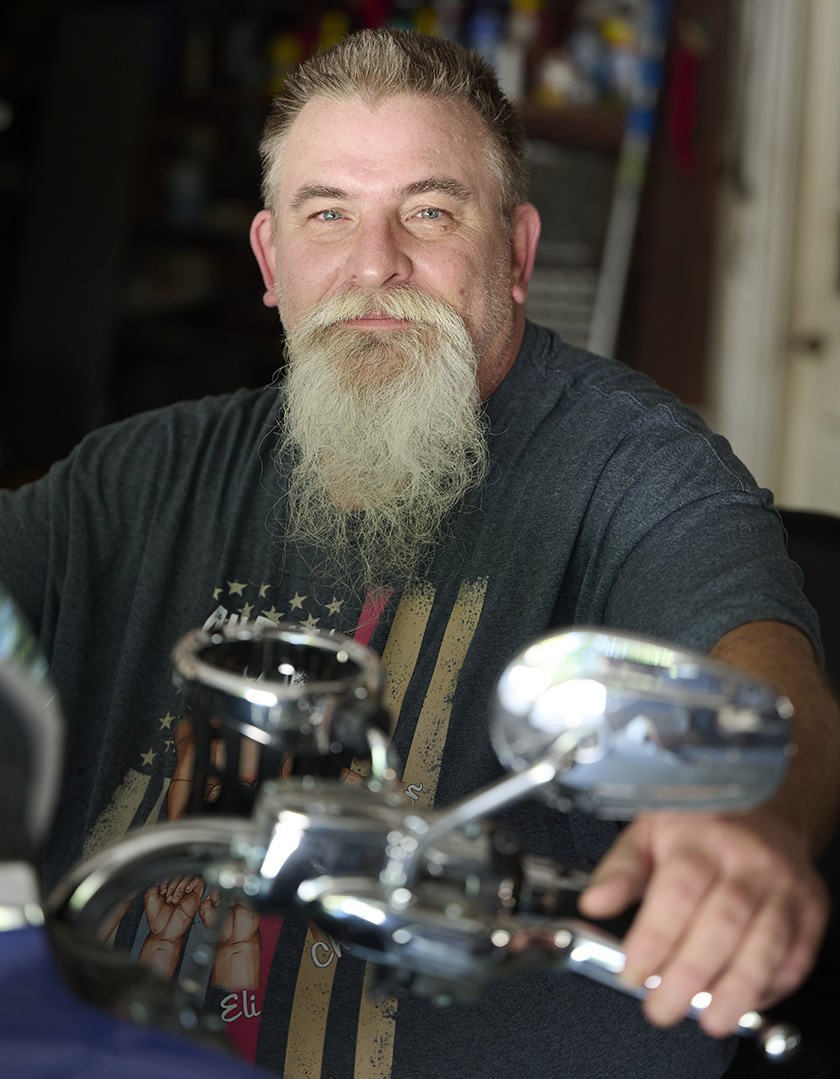 Not long after William’s accident, his son was born. He was holding the baby one night at home when his back seized. William’s wife, Teressa, had to rush to take hold of the baby before William lost his grip.
That scare was just one example of the bursts of lower back pain that became regular threats for William. His attempts to dodge flare-ups caused a different kind of damage.
The motorcycle William loved to ride got parked because he feared a fall. He regretted not being able to hop on carnival rides with his kids. When his family played its annual softball game, he watched from behind the fence. Later in life, he celebrated the arrival of five grandkids while also hiding a fear.
“I had to change the way I lived, and it upset me because I couldn’t play with my kids the way normal dads did,” William says. “With my grandkids, I was afraid they weren’t going to want to do anything with me—because I couldn’t do much.”
A new low
Dodging the pain became impossible for William in April 2023, when he woke up one day and could barely get out of bed.
Familiar but intensified sharp pain coursed through his lower back. And now a new, unpleasant sensation arrived. His foot was tingling, as if numb, but the feeling didn’t fade.
He waited a day, then another. Things didn’t improve. It dawned on him that he wasn’t going to be able to work. Walking it off was no longer an option.
“Nothing could relieve my pain this time,” William says. “I had to start walking with a cane. When I sneezed, it hurt. I knew it was bad and had progressively gotten worse over time, but I didn’t know how severe it was.”
A journey to relief begins
William, a transport driver for a metals company, went on short-term disability and committed to finally finding a lasting answer. He turned to Christian Hospital’s Pain Management Center, which referred him to Dr. Vasudevan to discuss the possibility of surgery after physical therapy and pain-management injections could not ease his pain.
“If you have persistent pain,” Dr. Vasudevan says, “and that pain is not just in your back, those are signs you may have a structural problem that could require surgery. If the pain comes along with other things, such as leg pain and weakness, difficulty walking, or bowel and bladder complications, those are signs as well.”
Dr. Vasudevan could tell from William’s medical images that he could benefit from a procedure called an L3-5 transforaminal lumbar interbody fusion (TLIF). The surgery removes damaged disks from the spine to relieve pressure on the spinal cord and its nerves. Compression in that area was causing William’s foot numbness. Titanium implants and hardware replace damaged bone and fuse together vertebrae to stop them from slipping and sliding on one another. Stabilizing this area meant stopping William’s unpredictable lightning bolts of back pain.
When discussing outcomes, Dr. Vasudevan stresses honesty. Back surgery involving a fusion often means a patient secures pain relief by surrendering some flexibility and range of motion.
“I was good with that if the operation eased my pain,” William says.
But first, Dr. Vasudevan and William had an important, impactful discussion about their partnership.
“Two of the biggest risk factors for the failure of a fusion surgery are obesity and long-term use of nicotine or smoking,” Dr. Vasudevan says.
“I’ve never been the skinniest thing in the world,” says William. “And I had smoked for 30 years. But I was so tired and in so much pain. I knew I had to do what this man wanted me to do, so he could try to help me.”
A successful partnership
William quit smoking immediately and adjusted his diet, decreasing his portion sizes during meals.
“We wanted to do the surgery because we saw that commitment in him,” Dr. Vasudevan says.
In late December 2023, Dr. Vasudevan performed William’s procedure at Christian Hospital.
As soon as he woke up, William realized his agonizing foot tingle was gone. He walked the next day and returned home the day after that, determined to continue his pre-surgery dedication through his post-surgery rehab.
For three weeks, William practiced bending, squatting, and stretching with the help of BJC Home Care’s rehabilitation experts. Five weeks of intensive outpatient therapy followed. Without fail, he wore a bone stimulator designed to help promote new bone growth in his back. By April 2024, William was cleared to return to work without restrictions. His steady progress continued through his final one-year checkup with Dr. Vasudevan.
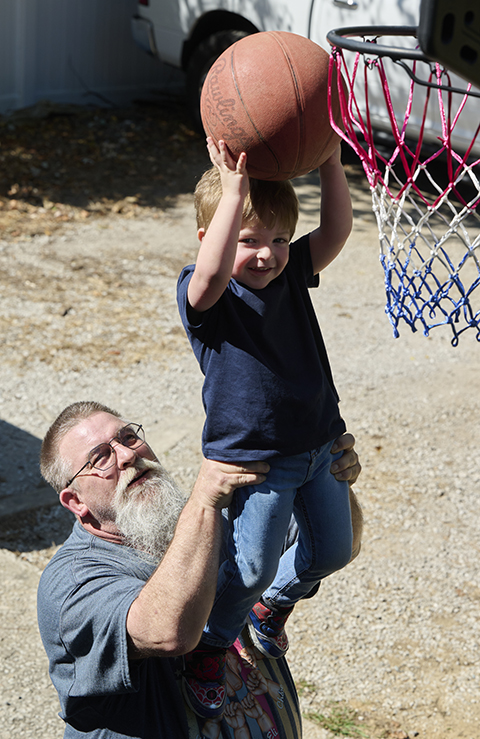
“I still get choked up thinking about it,” William says. “I can run after my grandkids and even wrestle them a little. I can swing a softball bat. I do my own landscaping and can take care of my own house. I don’t push it. When I get tired, I rest. But I’m enjoying life again. Dr. Vasudevan gave me my life back.”
To learn more, visit BJCs spine specialties.
Relevant News
Patient Story
Gastric Sleeve Surgery Helped a Mom Say Yes Again
News
St. Louis Children's Hospital Again Ranked No. 1 Children's Hospital in Missouri and St. Louis by U.S. News & World Report
Patient Story
A Trusted Doctor, a Mammogram, and Care That Stayed Connected
Patient Story
Old Friends Lean On One Another Through High-Risk Pregnancies
Patient Story
A Pregnancy Journey Built on Intention
Patient Story