Caring for Others, Caring for Herself
After a devastating fire and a life-changing diagnosis, Emily decided to put her own health first.
On the day of her mammogram, Emily George shifted position so the technologist could get a few more images.
The week before, her nonprofit, Journey of Hope, which began as a maternity home that sheltered and cared for pregnant women in crisis, suffered a devastating fire. No one was hurt, but as Emily faced the disaster, she considered postponing the mammogram.
Emily was 42, this mammogram would be her first, and she had already been putting it off for a while. It would have been easy to keep pushing out the date. Ultimately, though, the caregiver—who always put her family, children, church, and clients first—recognized it was time to tend to herself, too.
She kept the appointment at the Harold & Dixie LePere Breast Health Center, at Memorial Hospital in Shiloh.
“I thought, ‘This will be something to get done and off my plate,’" Emily says.
But now, Emily was being told she needed an ultrasound.
“I could just sense that they saw something,” she remembers.
After the ultrasound, a radiologist told Emily they needed to schedule a biopsy, which she underwent the next day. A few days later, the results were available.
Emily had Stage 1 breast cancer.
A grounding voice in an overwhelming moment
Sitting in the office of James J. Clanahan, MD, FACS, then director of the Breast Health Center, Emily was trying to absorb her diagnosis and all the treatment options. She describes it as an out-of-body experience. Dr. Clanahan, who has since retired, helped ground her.
“Dr. Clanahan explained everything in detail so that I knew what each option entailed, what the downtime and healing would be, and what the positives would be,” Emily remembers. “That helped me immensely to know that someone cared so much from the beginning. It was reassuring.”
For the mother of three, whose youngest child was 9 at the time, having a picture of what healing would look like helped her plan for how much support she would need.
“That support piece impacts more women who have breast cancer than we think,” Emily says. “Because you still have to take your child to school. You have to get them home from school. They need to eat. Life doesn’t stop, and it didn’t stop for me. BJC connects you with so many resources. They want to make sure you have what you need. They were aware of me as a whole person.”
Kimberly Widel, BSN, RN, Breast Health Center imaging manager, says the Center recognizes that every patient is different, and a compassionate and personalized approach is key. “If a patient needs a biopsy, they don't leave until they meet with the nurse navigator or myself,” she says. “I see the relief on their faces when they're in my office and realize we’re going to make their appointment together. I always say, ‘You’re not in this alone.'”
Also integral to the Breast Health Center’s approach is its leading-edge care. John Visconti, DO, of Washington University Physicians in Illinois, Inc., was Emily’s oncologist. He is a provider with Siteman Cancer Center at WashU Medicine and BJC HealthCare. Siteman is southern Illinois and Missouri’s top-ranked cancer center and the only National Cancer Institute-designated Comprehensive Cancer Center in the region. The Breast Health Center has also earned accreditation from the National Accreditation Program for Breast Centers, administered by the American College of Surgeons, an indicator of excellence.
Part of that excellence is The Breast Health Center’s multidisciplinary team—including its surgeon, radiologist, nurse navigator, and genetic counselor—which specializes in treating only breast cancer patients. This means the team has deep expertise in the unique needs of patients facing breast cancer. They participate in bimonthly conferences to share details on patients, their treatment plans, and the best next steps, so women can feel assured that their health is being assessed by a team of experts rather than a single provider. The Breast Health Center’s team must also participate in continuing education, as well as offer access to clinical trials, in this case, through WashU Medicine.
Because of Emily’s anatomy, a lumpectomy, a surgical procedure that removes a cancerous tumor while preserving the breast, wasn’t possible. She decided to move forward with a double mastectomy, a surgery in which both breasts are removed to treat cancer, and breast implants.
Carrying on while learning to slow down
Recovering from surgery, Emily relied on her two older children, mother, sister, and church community for help around the house. After
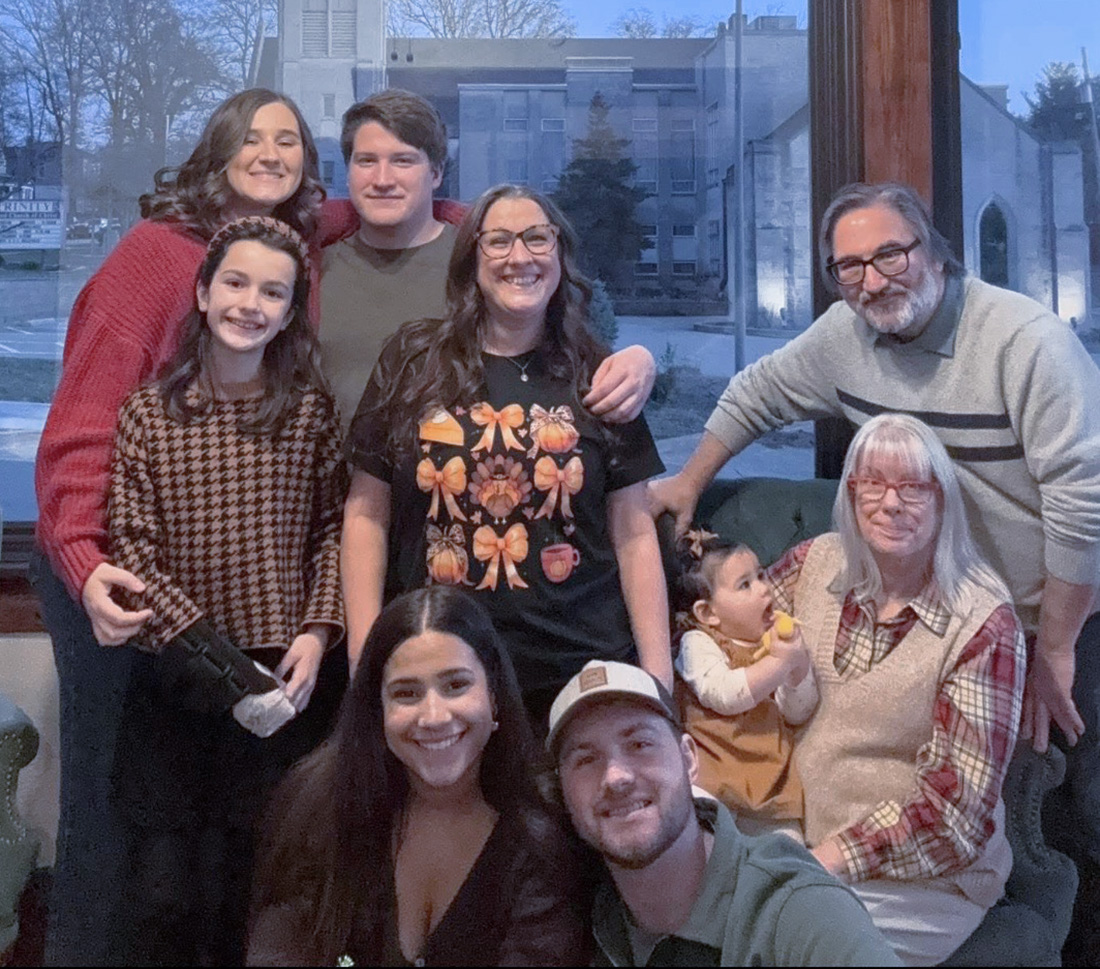
taking a month off of work, she dived back in, quickly pivoting Journey of Hope to serve pregnant women with wraparound services such as job assistance, housing assistance, and financial literacy courses. In 2024, the Memorial Foundation awarded Journey of Hope a grant to expand its programming and hire additional staff.
From the outside, it looked like Emily could carry everyone and everything. But her experience with the fire and the diagnosis that came only a week later left a mark. She was diagnosed with post-traumatic stress disorder and began therapy. It was a moment of clarity for her, one in which she recognized that for a long time, her body had been telling her to take care of herself, signs that she had ignored.
“I wondered how many other women are putting off their mammogram because they're serving other people, or taking care of everybody else except themselves,” Emily says. “We deserve to also be cared for even while we're caring for others. My biggest takeaway was to listen to my own body and slow down.”
Life after cancer
Now cancer-free, Emily receives monthly injections and takes daily medication to suppress her estrogen, critical for patients with hormone receptor-positive breast cancer.
Her oncologist, Dr. Visconti, was instrumental in helping find the right medications for her.

“When you present Dr. Visconti with a side effect, he wants to solve it,” Emily says. “He does not want you to be in pain or sat with an issue that’s making you feel miserable.”
After a couple of different medications, Dr. Visconti and Emily found one with minimal side effects.
Emily didn’t have to go through chemotherapy or radiation to treat her cancer. At times, when she was with other breast cancer patients who had to have those treatments, she felt guilty. She had so much to be grateful for, and at the same time, would think to herself, “My cancer is nothing compared to what everybody else is going through.”
“I had to rewire my brain and think, ‘This is your story, and just because you're not going through chemo and radiation doesn't mean that you haven't lost something,’” Emily says. “All of our journeys are so very individual. We need to be kind to ourselves.”
Mammogram recommendations
A mammogram is a low-dose X-ray image of the breast that can help detect breast cancer and other breast diseases. Mammograms are routine—asymptomatic women without a family history of breast cancer should start getting the screening annually beginning at age 40—and with breast cancer, early intervention is key. Breast cancer that is detected early and hasn’t spread has a five-year relative survival rate of 99%. Mammograms are essential to this early detection.
A screening mammogram is recommended for women:
- Yearly
- For those ages 40 and over
- Who are not experiencing breast issues
Who haven’t been sent by a provider for additional imaging
A diagnostic mammogram is recommended for women who have a clinical complaint such as:
- A lump
- Localized breast pain
- Nipple discharge
- Recent breast skin changes
Remember that monthly breast self-exams are also an important part of preventive health, and women ages 25–39 should receive a breast exam from their OB-GYN every one to three years.
Schedule your mammogram today.
Learn more about The Harold and Dixie LePere Breast Health Center.
Relevant News
Article
Seven Screenings to Help With Cancer Prevention
News
Memorial Hospital Earns NAPBC Accreditation for the Third Time
Article
How to Make Prepping for a Mammogram a Little Bit Easier
Article
Are Mammograms Effective? Debunking Myths About Diagnosing Breast Cancer
News